
Why Not Only Schools
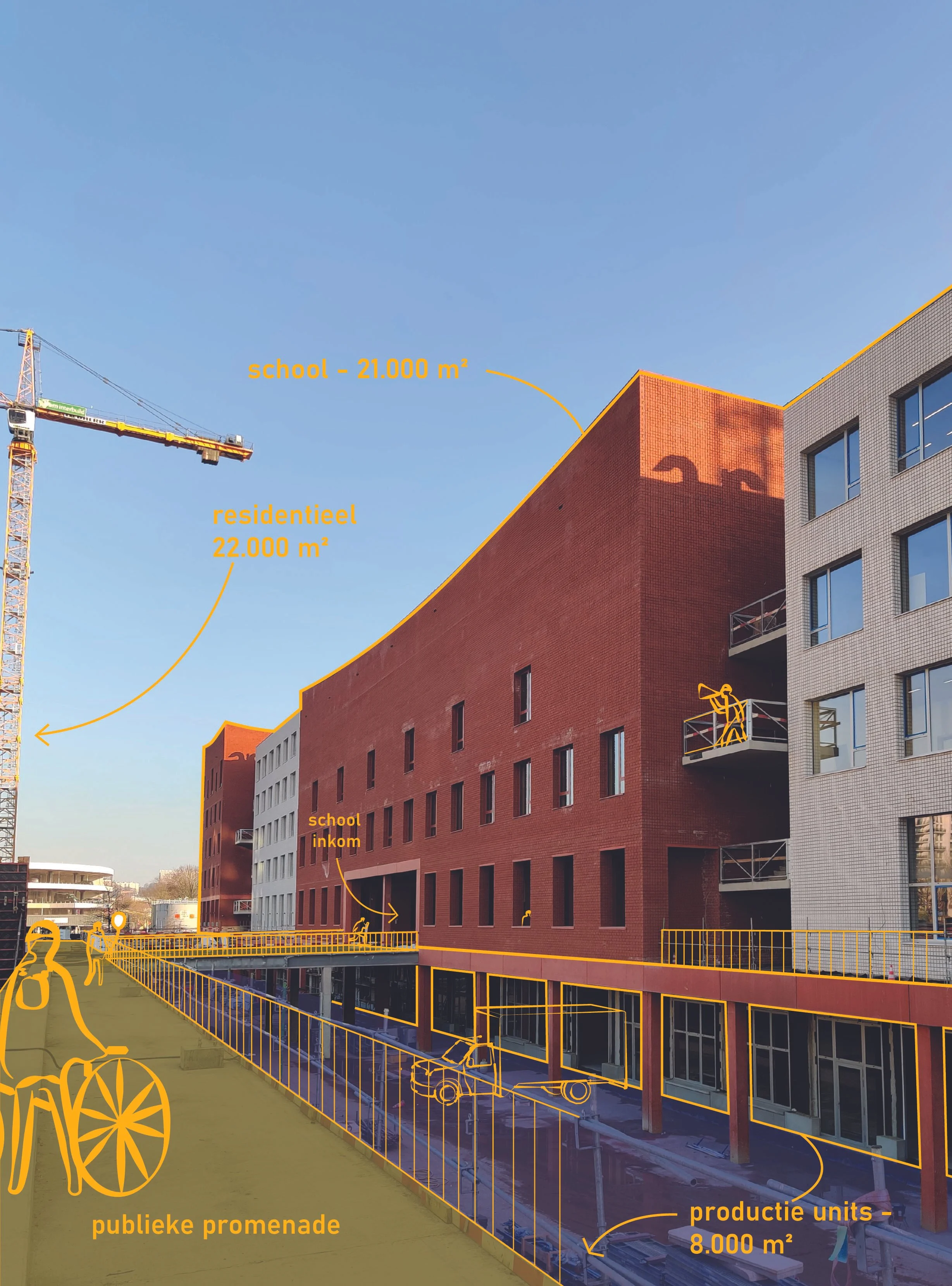

The Learning Neighbourhood:
Rethinking the Boundaries Between Education and Housing
Why Schools Are Not Enough is a cross-country design research project initiated and led by MAZi Architects and SMAK Architects, exploring how learning environments can be spatially, socially, and institutionally integrated with housing.
Developed in response to land scarcity, housing shortages, and increasing pressure on public infrastructure, the research challenges the traditional model of the school as a single-use, isolated building. Instead, it positions education as a form of civic infrastructure - embedded within neighbourhoods and intertwined with everyday urban life.
The study combines international case-study analysis, policy comparison, spatial evaluation and stakeholder interviews across Belgium, the Netherlands, the UK, Sweden and Greece. It examines built examples where schools and housing coexist, identifying design strategies, governance models, acoustic and environmental considerations, and structural systems that enable - or hinder - successful co-location.
Beyond analysis, the research moves toward implementation. Through site-specific scenarios and future-focused frameworks, it explores how education–housing hybrids could be delivered within different planning cultures and regulatory environments.
For MAZi and SMAK, the project positions research as an active design tool - supporting dialogue with municipalities, informing future commissions, and contributing to a broader conversation on how learning, living and civic life can meaningfully intersect in contemporary cities.
Design Research & Spatial Strategy
Typology
2025
Year
Cross-country
Location
On going
Status
MAZi Architects, SMAK Architects
Team
-
Contributors:
Jack Harvie-Clark, (APEX Acoustics, UK) Acoustics
Gustav Magnusson, (City of Malmö) Urbanism & public space
Sebastian Ekstam, (City of Malmö) Real estate & facility planning